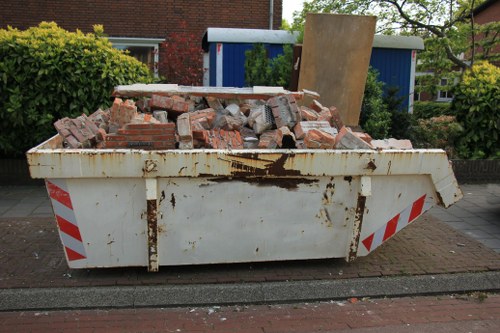
Health and Safety Policy for House Clearance Marlow
Purpose: This Health and Safety policy sets out the commitments and procedures of our house clearance and rubbish removal teams operating across the service area. The policy applies to all staff, contractors and subcontractors engaged in domestic and commercial house clearance, junk removal and general waste clearance activities. It is designed to reduce risk, prevent injury and ensure compliance with applicable safety standards while delivering professional clearance services.

Scope and Responsibilities
The policy covers the full range of clearance activities performed by our rubbish company, including estate clearances, loft and garage clear-outs, furniture disposal and hazardous item handling. Management is responsible for setting and maintaining safe systems of work; supervisors must ensure teams follow procedures on site; and each operative has a duty to work safely, report hazards and use personal protective equipment. Everyone is encouraged to speak up where concerns arise.
Risk Assessment and Site Control
All jobs begin with a documented risk assessment tailored to the specific Marlow-area property or service location. Assessments identify manual handling risks, trip and fall hazards, asbestos suspicion, sharps, biohazard contamination and environmental risks such as diesel or chemical spills. Control measures include clear exclusion zones, removal of ignition sources, safe access routes and method statements for heavy lifts. Tasks are only to proceed when the risks are understood and mitigated.
Training and Competence: Staff receive regular training in manual handling, waste segregation, safe use of equipment, and first aid. Certification for specialist tasks (for example, hazardous waste classification) is maintained on file. Competence checks and toolbox talks are conducted before complex clearances to ensure adherence to safety protocols.
Personal Protective Equipment (PPE): Appropriate PPE is issued and must be worn at all times on site. This includes gloves, steel-toe boots, high-visibility clothing and respiratory protection where dust, mould or asbestos may be present. Supervisors will enforce PPE usage and replace worn or damaged items promptly.
Operational Procedures for Rubbish Removal
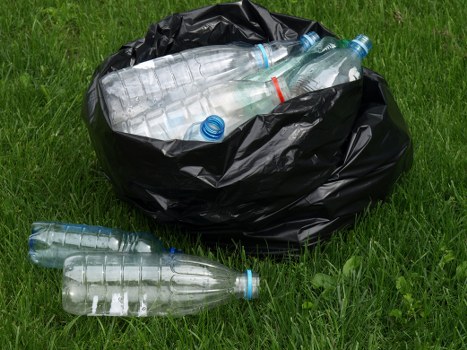
Safe operational procedures are in place to protect staff, clients and the public. These procedures cover vehicle loading and securement, safe stacking of items, use of mechanical aids such as trolleys and hoists, and restrictions on lone working for high-risk tasks. Waste separation and recycling steps are documented to support environmental responsibilities while reducing manual handling risks.
Key control actions include:
- Pre-job planning to identify access constraints and parking for removal vehicles
- Clear communication of roles and signals during lifts and transfers
- Continuous monitoring of weather and site conditions that might affect safety
Hazardous Materials and Waste Streams
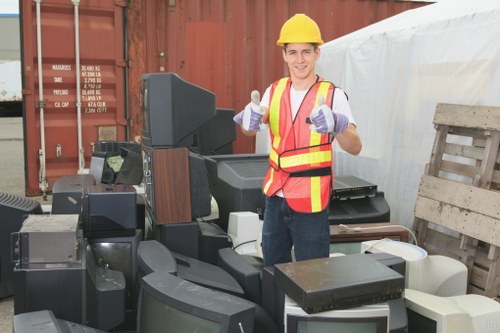
Certain items encountered during a clear-out may present specific hazards: asbestos, solvents, batteries, medical waste and sharps. These are segregated on-site and handled by trained personnel using designated containers. Legal requirements for disposal are followed and records retained. Where asbestos or medical risk is suspected, work will be paused and specialist removal arranged.
Incident Reporting and Emergency Response: All accidents, near-misses and dangerous occurrences are reported immediately to management and recorded. An emergency response plan addresses first aid provision, spill containment, and liaison with emergency services. Regular drills and reviews ensure the response remains effective.
Maintenance of equipment, regular vehicle inspections and safe loading checks are carried out to prevent mechanical failures that could cause injury. Vehicles are loaded to manufacturer limits and secured to prevent shifting in transit. Drivers and loaders work together to ensure compliance with road safety and manual handling rules.
Health and Wellbeing: We recognise that clearance work can be physically and mentally demanding. Policies support reasonable working hours, hydration and rest breaks, and access to occupational health advice where needed. Employees are encouraged to report fatigue, stress or any condition that may impair safe performance.
Monitoring, Review and Continuous Improvement: This policy is reviewed at regular intervals and after any significant incident. Performance is monitored through site inspections, audits and safety meetings. Lessons learned feed into updated procedures and further training to continuously improve the safety of our clearance operations.
Compliance and Enforcement: Compliance with this policy is a condition of employment. Failure to follow safety procedures may lead to disciplinary action. The company will also cooperate fully with regulatory inspectors and implement any required remedial actions promptly.
Final Statement: Our approach balances efficient house clearance and rubbish removal services with a firm commitment to health and safety. By planning work, training staff, controlling hazards and encouraging a culture of responsibility, we aim to deliver safe, reliable clearance solutions across our service area while protecting people and the environment.
All personnel are required to read this policy and adhere to its provisions. Management will ensure it remains accessible and communicated to every operative and contractor involved in clearance work.
